
Johnson County Court Records After Arrest
An arrest in Johnson County usually creates a jail booking record first. The person is brought through Central Booking, intake data is created, and the sheriff's roster may show the arrest agency, booking date, charges, bond, warrant comments, and court date. The court record is separate. It begins when the Johnson County District Attorney, Stephen M. Howe, files or declines charges in the court system.
That split matters because booking charges are not convictions and may not match the filed court charge. A charge can be amended, reduced, dismissed, or refiled as the case moves. Use Johnson County jail inmate records for custody and booking details. Use Johnson County jail mugshots for booking-photo questions. Use Kansas Case Search for the court records after a jail arrest.
Search Court Records After Arrest
Johnson County's sheriff page explains that the 10th Judicial District moved to the statewide centralized case-management system. Starting November 5, 2024, online historical records and new case filings can be found through the public portal. It also warns that case numbers displayed in sheriff booking/release and inmate-search systems may not match the formatting used on the statewide portal.
- Open Kansas Case Search.
- Search by party name, case number, business name, or citation when available.
- Use the statewide case-number format if the sheriff number does not match.
- Open the criminal case record and review charges, events, hearings, and disposition fields.
- Check courthouse terminals when older records are not available online.
The Kansas Judicial Branch says public district court records are available through statewide tools, with older or unavailable materials accessible at courthouse terminals. For Johnson County district criminal cases, the court record lives in that court system rather than in the jail booking report.
The Kansas Case Search portal is the central online search point for Johnson County court records after a jail arrest.
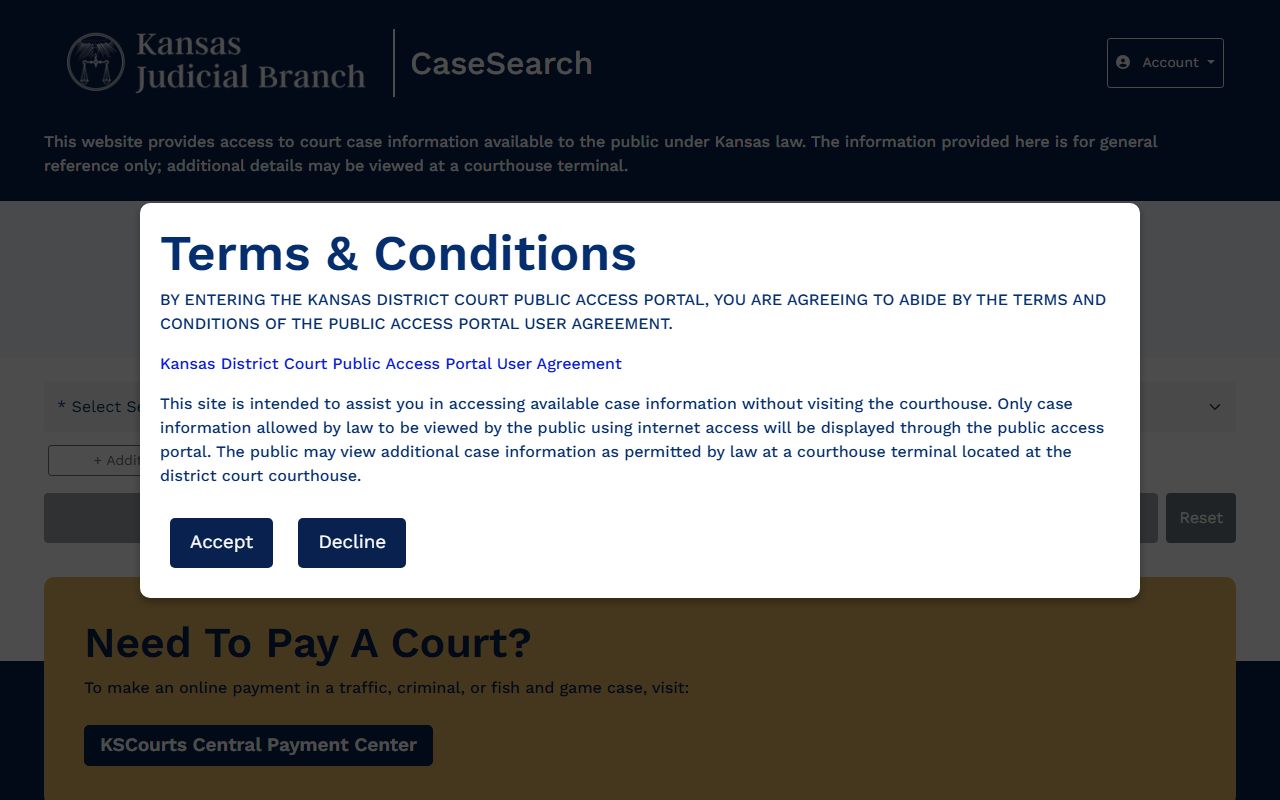
This portal is also the place to re-check first appearances after the sheriff's roster warns that jail-displayed court times may change.
Johnson County Case Search Fields
Kansas Case Search is broader than the sheriff's inmate roster. It can search for district court records by case number or party information. A citation field may help with traffic or municipal-style matters when a citation exists. The portal notes that available criteria can vary by user role.
| Field Label | Type | Use | Notes |
|---|---|---|---|
| Case number | Search criterion | Known district court case | Use statewide format when possible. |
| Party name | Search criterion | Defendant or person search | Most useful when no case number is known. |
| Business name | Search criterion | Business party cases | Less common for jail-arrest questions. |
| Citation | Search criterion | Traffic or citation-linked matters | Use if the booking or court notice lists one. |
| Role-based criteria | Varies | Portal user role | Options may differ by account or access type. |
Charges Filed After Arrest
The arrest-to-court path is a sequence: arrest, booking, first appearance, prosecutor review, filing decision, and court case activity. The charging document is what turns a police or jail allegation into a court record. Kansas criminal cases most often move through a complaint or information, while an indictment can be used when a grand jury is involved.
| Document | Who Uses It | Plain Meaning |
|---|---|---|
| Complaint | Prosecutor or law-enforcement-supported filing | Starts many criminal cases by setting out the alleged offense. |
| Information | Prosecutor | Formal charge document often used after prosecutor review. |
| Indictment | Grand jury process | Formal charge returned by a grand jury. |
The Johnson County District Attorney's Office is at 150 W. Santa Fe St., Olathe, KS 66061, phone 913-715-3000. Its role is to review law-enforcement submissions and decide what charges, if any, are filed in court.
Johnson County Charge Status
Charge status terms describe where the court record stands. A pending charge is unresolved. An amended or reduced charge means the prosecutor or court changed the charge from the original allegation. A dismissed charge is no longer proceeding in that case. A disposition is the court outcome, and a conviction is an adjudicated result after a plea, verdict, or other qualifying finding.
| Status | What It Means |
|---|---|
| Pending | The court case or charge remains unresolved. |
| Amended / Reduced | The charge changed from the original booking or filing language. |
| Dismissed | The charge is not proceeding in that case. |
| Disposition | The court's outcome for a charge or case event. |
| Conviction | A final adjudicated result, not the same as a booking allegation. |
Bond After Johnson County Arrest
Bond information can appear in both jail and court records, but the meaning depends on holds and court orders. The sheriff's bonding page lists District Court bond categories such as cash-surety, personal recognizance, and ORCD. Cash bonds require exact cash or GPS/Government Payment card bond. Cashier's checks and money orders are not accepted. ORCD bonds require 10 percent of the total bond in cash when ordered by the court.
| Bond Type | Johnson County Note |
|---|---|
| Cash | Exact cash or approved card bond; no cashier's checks or money orders. |
| ORCD | Court-ordered own-recognizance cash deposit at 10 percent of total bond. |
| PR | Personal recognizance category listed by the sheriff. |
| Surety | Approved bonding company, with list in both lobbies and on the sheriff page. |
| Municipal cash | Lenexa, Olathe, and Overland Park cash bonds must be posted with those cities. |
A bond amount does not guarantee release. Another warrant, no-bond hold, probation matter, court commitment, detainer, or ICE-related hold can keep a person in custody even when one charge has a bond listed.
Warrants After Jail Arrest
The Johnson County Sheriff runs a separate warrant search portal. It accepts last name, first name, and a city dropdown that includes Johnson County cities such as Olathe, Overland Park, Lenexa, Shawnee, Gardner, Leawood, Prairie Village, and others. Results can show warrant type, issue date, age, race, sex, and details such as warrant number, case number, bail amount, and bail type.
A warrant can lead to a booking event, and a booking event can show warrant comments or bond status. Municipal bench warrants may also involve municipal courts or city payment rules. When a warrant ties to a district court case, Kansas Case Search may show the case activity behind the warrant.
Charges Versus Convictions
Being arrested and charged is not the same as being convicted. A charge is an accusation or filed allegation. A conviction follows a plea, verdict, or other court result that adjudicates guilt. Johnson County court records after a jail arrest should be read with that distinction in mind, especially when a booking report shows early charges before prosecutor review.
| Point | Charge | Conviction |
|---|---|---|
| Stage | Allegation or filed count | Final adjudicated result |
| Can change? | Yes, it can be amended or dismissed | Changes only through later court action |
| Appears where? | Jail roster and court case records | Court records and some correctional records |
Sealed and Expunged Records
Kansas expungement is governed by K.S.A. 21-6614, which provides a process for certain convictions, arrest records, and diversion agreements. Expungement is not the same as a routine jail roster update. A person normally must use the court process and meet the statute's conditions.
| Point | Sealed or Restricted | Expunged |
|---|---|---|
| Public view | Hidden or limited by law or court rule | Treated as cleared under the expungement order |
| How it happens | Specific law, order, or record type | Petition and court order under Kansas law |
| Applies to | Juvenile, protected, or restricted records when law allows | Eligible convictions, arrests, and diversions |
Restricted Johnson County Court Records
KORA opens public records unless a specific law closes them, but not every law-enforcement or court item is public. Juvenile matters, sealed cases, certain investigations, protected personal information, and legally restricted materials may be withheld or redacted. K.S.A. 45-221 also requires separation of open and closed information when a record contains both.
Important: Public court and jail lookup tools are not FCRA consumer reports and cannot be used for employment, tenant, credit, or insurance screening.